
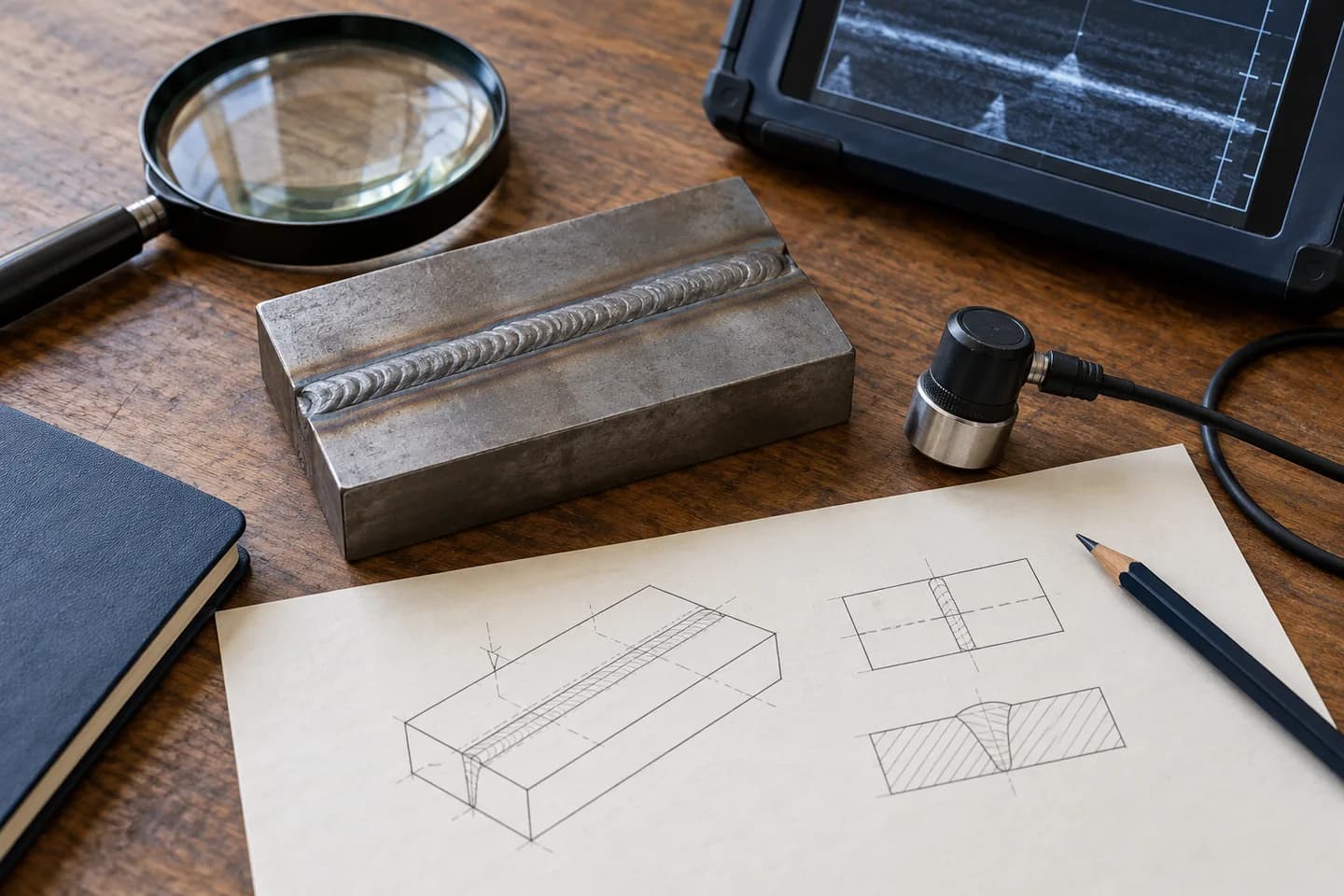
Requesting “a nondestructive test” without explaining what you need to learn can lead to an incomplete proposal. NDT provides information about a component without destroying it, but no single method answers every question. Start with the inspection objective.
What needs to be checked?
Reviewing surface condition, assessing a weld and measuring thickness loss are different tasks. Identify the component, known material, service conditions and reason for the inspection. Share previous findings and areas of concern without describing them as confirmed defects.
Four methods with different capabilities
Visual testing assesses observable conditions with suitable access and lighting. Liquid penetrant testing reveals surface-breaking discontinuities in nonporous materials. Magnetic particle testing applies to ferromagnetic materials for certain surface and near-surface discontinuities. Ultrasonic testing may assess thickness or internal conditions, depending on technique, geometry and material.
This comparison supports a discussion; it does not replace technical method selection. A satisfactory result from one method does not prove every possible discontinuity has been excluded.
Access can change the proposal
Geometry, coatings, surface condition and accessible faces influence inspection. Overall and close-up photographs help assess feasibility. Flag covered or restricted areas before personnel and equipment are mobilized.
What will the result be assessed against?
Finding an indication does not automatically mean rejecting a component. Assessment depends on the procedure and applicable acceptance criteria. Agree on who defines those criteria, which areas will be inspected and which limitations must be recorded.
A better-prepared request
- Identify the component, material and location.
- Explain the question: surface, thickness, weld or another condition.
- Include drawings, photographs and available history.
- State the required code or specification, if already defined.
- Confirm access, availability and the expected report scope.
TERANING presents its nondestructive testing service through applications. Method selection and scope are validated before the work. That preliminary discussion helps obtain decision-useful information instead of choosing a test only by name.
ASNT — What is nondestructive testing? ↗